BLUF: Building a "simple" in-house CSV importer is a trap. What looks like a three-day task quietly grows into a custom ETL pipeline, an error-reporting system, an async processing queue, and — when the enterprise customer sends a scanned PDF — an OCR project. The hidden cost is your product roadmap.
It's a scenario every B2B SaaS leader knows well. You've just signed a major new customer. The contracts are done, the kickoff call was a success, and the only thing standing between you and a "go-live" announcement is getting their historical data into your platform.
In the planning meeting, an engineer says the magic words that sound like music to a product manager's ears:
It's mostly just CSVs. We can build an importer for that in a few days.
It seems so logical. So simple. A self-contained project with a clear outcome. But this seemingly small task is a Trojan horse. Building a "simple" data importer isn't a quick win — it's the beginning of a slow, resource-draining journey. A death by a thousand paper cuts that distracts your team from your core product and stalls the very onboarding it was meant to accelerate.
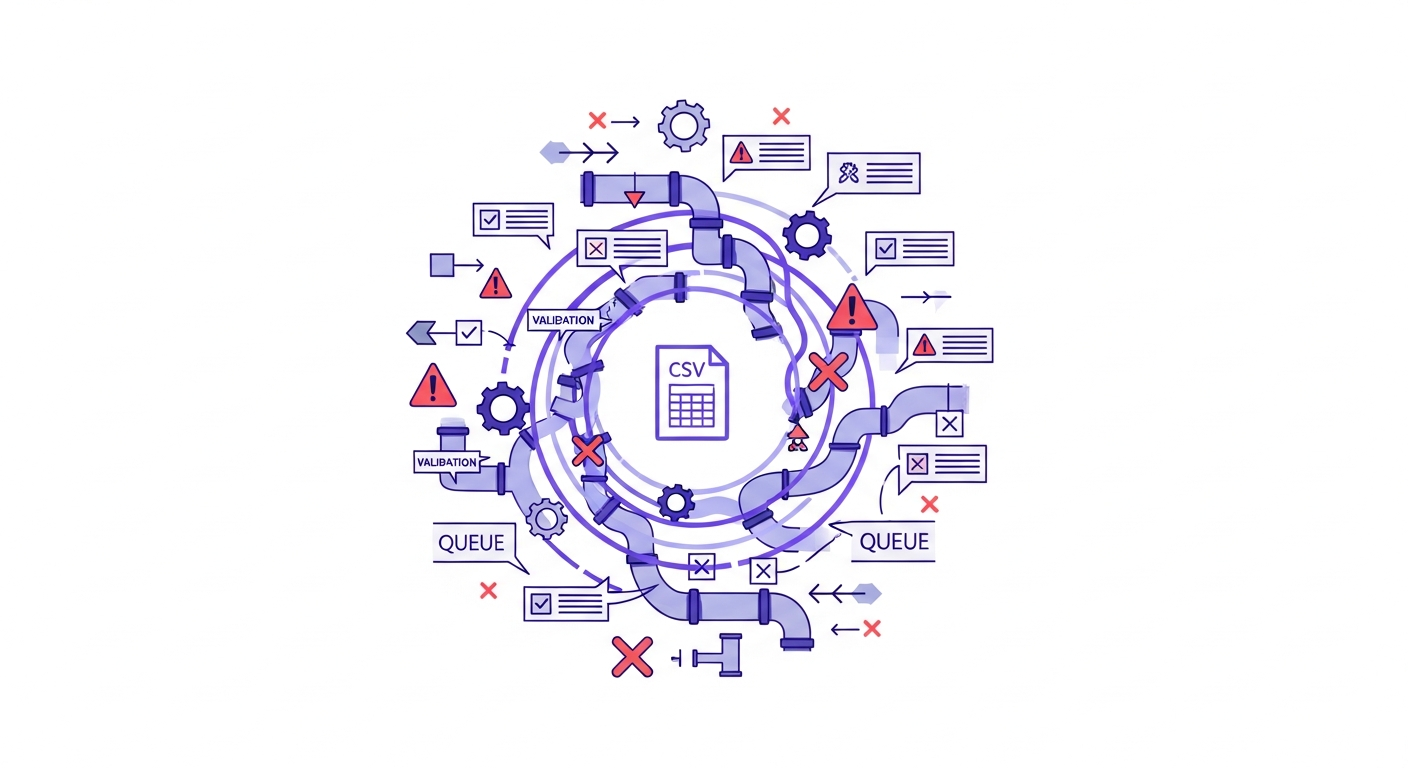
The First Paper Cut: The Myth of "Clean Data"
A few days later, version one of the uploader is ready. The team grabs the first real file from the new customer, uploads it, and… it breaks.
This is the first paper cut. The naive assumption that customer data will be clean and predictable immediately evaporates. The team digs in and finds:
- Inconsistent date formats (
MM/DD/YYYY,DD-Mon-YY,YYYYMMDD). - Surprise
NULLvalues in supposedly required columns. - Hidden characters, trailing whitespace, and bizarre encoding issues.
- Phone numbers with and without country codes, brackets, and dashes.
The fix seems easy enough. "No problem," the team says. "We just need some basic validation and sanitization." The scope creeps, just a little.
The Second Paper Cut: From Validation to Complex Business Logic
The importer now rejects messy data. Success! But the next customer file fails for entirely new reasons. The data is technically clean, yet it violates fundamental business rules.
This cut is deeper. You realize you don't just need to validate data in isolation — you need to validate it in context:
- The cross-column conundrum: a file where
Subscription_End_Datefalls beforeSubscription_Start_Date. - The duplicate-data dilemma: a
user_idthat already exists in your production database. - The picklist problem: your system expects
statusto be "Active," "Pending," or "Cancelled" — the customer sends "active," "pending_review," and "Canceled."
Now your team is building logic to compare columns, making expensive calls to the live database mid-validation, and writing mapping rules to normalize synonyms. The "simple importer" is starting to look a lot like a custom ETL pipeline.
The Third Paper Cut: A Terrible User Experience
The importer is smarter now, but to the customer it's a frustrating black box. They upload a 10,000-row file and all they see is a generic Import Failed.
Your implementation manager is on the phone for hours, trying to explain that the error is on line 7,432. The paper cuts come faster:
- The black-box failure: engineers have to build a human-readable error report showing customers exactly which rows failed and why.
- The re-upload cycle of pain: the customer fixes 50 bad rows and re-uploads the entire 10,000-row file, praying they got it right.
- The waiting game: a larger customer uploads 500,000 rows. The request hangs for five minutes, then times out. Now you need an asynchronous processing queue with background workers just to handle large files without crashing the server.
Weeks have gone into an error-reporting system, a file-processing queue, and a notification service — all to support a "simple" three-day task.
The Sucker Punch: They Sent Scanned PDFs
Then comes the moment of truth. A high-value enterprise client — crucial for the quarter — is ready to onboard. They send their "data."
It's not a CSV.
It's a 150-page scanned PDF of shipping manifests. A folder of unstructured invoices. A sprawling Excel workbook full of merged cells, pivot tables, and a dozen tabs.

The parser your team painstakingly built over the last month is completely useless. This isn't a paper cut; it's a sucker punch — and it just exposed a real business risk. You're forced to choose between:
- Pulling senior engineers off the roadmap to build OCR and unstructured-data processing.
- Forcing your implementation team to re-type data from PDFs by hand.
- Telling your flagship customer their format isn't supported — killing their Time-to-Value and souring the relationship on day one.
Stop the Bleeding. Offload the Nightmare.
What started as a small feature has spiraled into a fragile, high-maintenance internal product. It has consumed weeks of your most valuable resource — engineering time — and it still can't handle the messy reality of customer data.
This entire painful journey is why we built Elvity. Your business shouldn't be in the business of building data importers. You should be focused on your core mission.
Elvity is an intelligent data ingestion platform designed to absorb this complexity so you don't have to:
- Tired of messy data and validation logic? Elvity's AI-powered validation and transformation engine handles everything from date normalization to complex, cross-column business rules out of the box.
- Frustrated with the user experience? Elvity gives your customers a beautiful, embeddable uploader where they map columns and fix validation errors themselves, instantly. No error reports. No back-and-forth.
- Terrified of PDFs and unstructured data? This is our specialty. Elvity parses unstructured files like PDFs, invoices, and complex Excel sheets, automatically extracting the structured data your system needs. That enterprise customer becomes your easiest onboarding yet.
Stop letting a "simple" data importer bleed your roadmap dry. Let your engineers get back to building features that innovate, and let your customer success teams deliver value on day one.
If you've made the call to buy, the CTO's guide to evaluating data onboarding companies walks through exactly what to look for in a vendor.
Ready to stop the death by a thousand paper cuts? See how Elvity automates customer data onboarding on the SaaS Importer page, or read case studies from teams that made the switch.