
In the world of healthtech, product velocity is everything.
If you are building a modern digital health platform, virtual clinic, or healthcare marketplace, your growth relies on delivering a frictionless, consumer-grade experience. Patients expect to find a provider, see their out-of-pocket price upfront, and book an appointment in under 60 seconds.
To make that booking and onboarding experience instant, your platform takes on a silent but significant administrative risk: estimating patient responsibility prior to service.
Because digital health platforms often guarantee provider payouts, getting this estimate wrong doesn't just trigger an awkward billing conversation—it directly drives bad debt, operational bottlenecks, and an endless stream of manual workarounds.
If you’re a CTO or VP of Product, you already know how painful this is. But what you might not realize is just how much of your core engineering capacity is being slowly devoured by a silent drain: The Eligibility Tax.
🤝 The Reality: You've Already Built the Pipes
Let's address the elephant in the room. If you are operating a successful healthtech business at scale, your engineering team hasn't "dropped the ball" on eligibility.
You have already built automated electronic checks. You have integrated with major clearinghouses. You are sending electronic queries, receiving responses, and successfully confirming whether a patient’s insurance card is "Active" or "Inactive."
The basic pipes are working.
graph LR
    User[Patient Booking] -->|Triggers Check| EHR[Your Platform]
    EHR -->|270 Inquiry| CH[Clearinghouse]
    CH -->|271 Response| EHR
    EHR -->|Confirm Coverage| User
The real problem isn’t the active-status flag. The problem is the sheer, compounding weight of the long-tail of insurance rules—the complex, non-standard benefit carve-outs that occur after the connection is made:
- Does this specific PPO plan cover outpatient psychotherapy with a Licensed Clinical Social Worker (LCSW) differently than a Licensed Marriage and Family Therapist (LMFT)?
- Is the patient's deductible remaining up-to-date, or is there an active "accumulator drift" due to in-flight claims from other doctor visits?
- Does the telehealth benefit bypass the deductible, or is it subject to a flat copay?
When these questions generate billing errors, your core software developers are pulled off high-value product features to write custom parsers, hunt down legacy codes, and debug broken APIs.
📐 Schema Ownership vs. Engine Maintenance: The Architectural Separation
When considering how to solve the eligibility problem, healthtech architects often arrive at a valid objection: "Our internal database schema and clinical workflows are highly customized. A third-party SaaS cannot possibly know what our normalized form needs to be."
They are entirely correct.
Only your company understands the precise data structures, relational models, and business logic of your proprietary EHR and billing engine. Your database schema is a core differentiator, and no external tool should dictate its shape.
Therefore, the normalization target must be defined locally by your team, to your exact requirements.
But there is a critical architectural distinction between defining the target schema and building and maintaining the transformation engine:
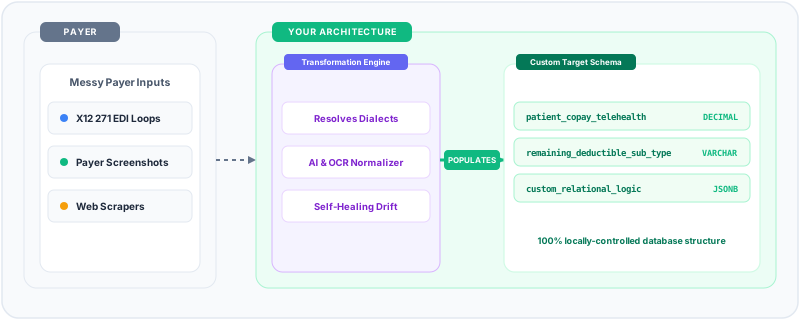
Think of this like database migrations. Your developers write the migration scripts to define the database columns (e.g., patient_copay_telehealth as a decimal), but they do not write the SQL query parser, database engine, or execution optimizer from scratch. They leverage PostgreSQL or MySQL as a utility.
Eligibility normalization is no different. Your engineering team defines the What—the exact destination schema, data types, and validation rules that your platform requires. Elvity’s AI engine handles the How—the complex, low-leverage task of reading messy payer dialects and mapping them into your exact shape.
You retain 100% control of your data architecture while outsourcing 100% of the maintenance overhead.
🗃️ The HIPAA Loop 2110C Trap: Why Rules-Based Parsers Fail
Under the hood, healthcare eligibility data is communicated via the federally mandated ANSI X12 271 EDI transaction set. In a perfect world, this data would return as clean, standardized database rows.
But in reality, insurance carrier mainframes are slow and expensive to update. When carriers introduce new, multi-tiered benefits, they don't modify their structured database columns. Instead, they write these complex rules as free-form human English and dump them into the MSG (Message) segment of HIPAA Loop 2110C (Benefit Eligibility Detail).
Here is a look at a raw eligibility segment:
EB*1**30**OUT*Mental Health~
DTP*291*RD8*20260101-20261231~
MSG*BEHAVIORAL HEALTH OUTPATIENT COPAY IS $30 PER VISIT. IN-NETWORK PREVENTATIVE SERVICES BYPASS THE DEDUCTIBLE. TELEHEALTH SUBJECT TO DEDUCTIBLE.~
The Rules-Based Maintenance Trap
Traditional JSON APIs and in-house rules-based parsers are hardcoded. They see EB01*1 and think: "Active plan, $30 copay!" They completely miss or ignore the unstructured text notes in the MSG segment.
To handle this, developers write custom Regular Expressions (Regex) to scan the text blocks for keywords. But this creates an unsustainable engineering loop:
- Companion Guide Fragmentation: Every single insurance carrier (Aetna, Cigna, UnitedHealthcare, and dozens of regional Blue Cross plans) has its own unique, 200-page "EDI Companion Guide"—a dialect manual detailing how they format their text responses.
- The Service Type Code (STC) Routing Maze: Payer mainframes respond differently depending on the code queried. Querying Service Type Code
30(General Benefit) might yield complete rules, whereas queryingMH(Mental Health) orA4(Psychiatric) on the exact same carrier might return a "Not Covered" error because of legacy database routing gaps. - Endless Regex Maintenance: The moment a carrier alters a single word in their text note (e.g., changing "SUBJECT TO PLAN YR DEDUCTIBLE" to "CY DED APPLIES"), your regex parser silently fails. The claim falls back to your manual operations queue, or worse, generates an incorrect patient charge.
📉 The Anatomy of a $600 Billing Leak
When rules-based parsers hit an unmapped payer dialect, the financial consequences are immediate. Here is a typical scenario that occurs thousands of times a week across the digital health landscape:
| Step | Platform Workflow | Financial Exposure |
|---|---|---|
| 1. Booking | A patient books 5 weekly therapy sessions at a contracted therapist rate of $150/session. | Est. Patient Cost: $30 Copay |
| 2. Estimation | Your automated parser reads the standard loops but misses the free-text MSG segment: "Outpatient mental health subject to individual $1,500 deductible." | Total collected upfront: $150 ($30 × 5) |
| 3. Payout | The therapist conducts the sessions, and your platform guarantees their biweekly payout. | Total paid to clinician: $750 ($150 × 5) |
| 4. Adjudication | You submit the claims to the insurance carrier. The insurer rejects them, stating the deductible has not been met. | Insurance payment: $0 (Patient owes full $750) |
| 5. The Gap | Your platform must now try to collect the outstanding $600 balance from the patient. | Uncollected Debt: $600 |
At this point, you face a painful operational trade-off:
- Scale Your Billing Ops Headcount: Hire more manual verification specialists to log into Availity portals, read the fine print, and manually override benefits.
- Scale Your Engineering Support: Pull your core software developers off your product roadmap to write another custom parser for that specific carrier dialect.
Both options lower your company’s velocity.
🛡️ Beyond the Plumbing: The Intelligent Normalization Layer
To break free from this cycle, healthtech platforms must separate data routing from data intelligence.
Traditional clearinghouses are excellent at routing envelopes securely, and modern APIs are great at converting raw loops to JSON. But neither is designed to interpret, translate, and audit unstructured human-written benefits text.
Instead of building and maintaining a fragile in-house parser, modern engineering teams are integrating an intelligent normalization layer that sits directly between their clearinghouse responses and their production database.
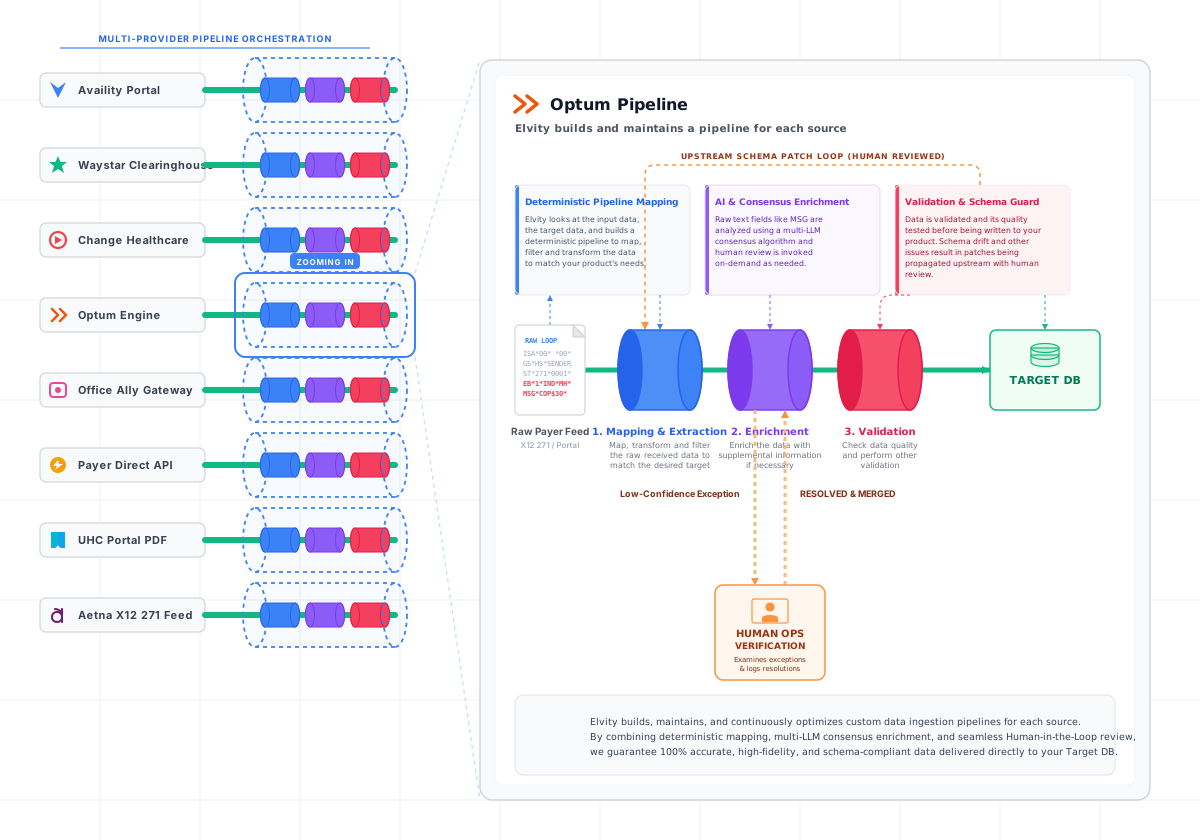
The Core Requirements of an Eligibility Normalization Engine
To support an enterprise-grade RCM workflow, an intelligent ingestion utility must deliver three distinct capabilities:
- AI-Powered Consensus Translation: Rather than fragile regular expressions, the engine utilizes multi-model AI consensus to read, interpret, and structure free-form text comments into precise financial values—regardless of the payer dialect.
- Self-Healing Schema Normalization: When a carrier alters their portal layout, companion guide, or text structure, the uploader self-heals, automatically re-aligning the shifted fields to your canonical target schema without throwing errors or breaking production.
- Coordinate-Level Lineage (No "Black-Box" AI): In healthcare billing, you cannot make financial decisions based on blind trust. Every parsed benefit must be completely auditable. Developers and billing operations must be able to hover over a standardized field (e.g., "Copay: $30") and instantly trace it back to the exact coordinate of a portal screenshot or the exact line of the raw X12 271 file.
🚀 Reclaim Your Engineering Velocity
Building a game-changing digital health product is about focus. Every hour your core software engineers spend debugging legacy EDI companion guides, maintaining regular expressions, or troubleshooting carrier portal scrapers is an hour stolen from your core platform experience.
You don't need to replace your clearinghouse or rebuild your core billing loops. By integrating a dedicated data normalization utility like Elvity, you can offload the entire eligibility tax.
Let your engineers build the future of healthcare delivery—and let Elvity handle the administrative complexity.
Want to see how easy it is to standardize unstructured payer benefit data? Explore Elvity’s Developer API or schedule a technical deep-dive with our integration team.