A property management migration does not move one kind of data. Structured records describe residents, owners, leases, units, vendors, work orders, and transactions. Files provide the contracts, inspections, notices, IDs, invoices, and images that give those records evidence and context.
Moving the rows without their attachments leaves an obvious gap. Moving the files without their relationships creates a less obvious one: the content exists, but users cannot reliably find it from the entity or workflow where it belongs.
The fragile object is the relationship
Legacy systems may represent an attachment through a database row, an object-storage key, a parent record ID, a document category, and application-specific rules. A generic export can separate the binary file from that metadata.
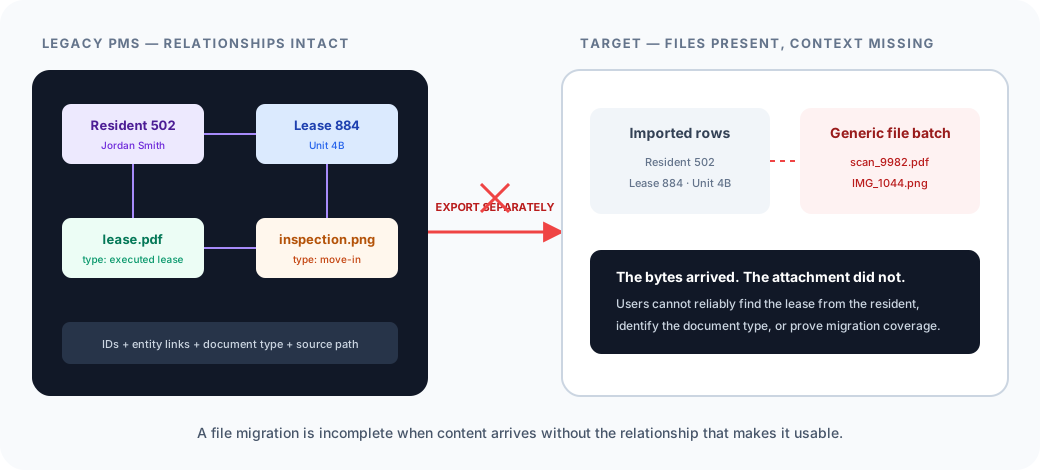
A folder containing every source file can still be a failed migration if the target cannot restore who and what each file supports.
A file has more than a filename
| Manifest field | Why it matters | Common failure |
|---|---|---|
| Source file ID and path | Provides a stable reference back to the source | Only a renamed export filename survives |
| Content checksum | Confirms the loaded bytes match the extracted object | Counts match while a file is truncated or substituted |
| Parent entity and record ID | Identifies the resident, lease, unit, owner, vendor, or work order | The file arrives in a general document library |
| Document type and date | Supports target categorization, search, and workflow rules | Everything is classified as “other” |
| Target entity and attachment ID | Proves where the file landed | The load reports success without a retrievable destination |
| Outcome and exception reason | Keeps unsupported formats and ambiguous links visible | Failed files disappear from aggregate success counts |
Start with a document manifest
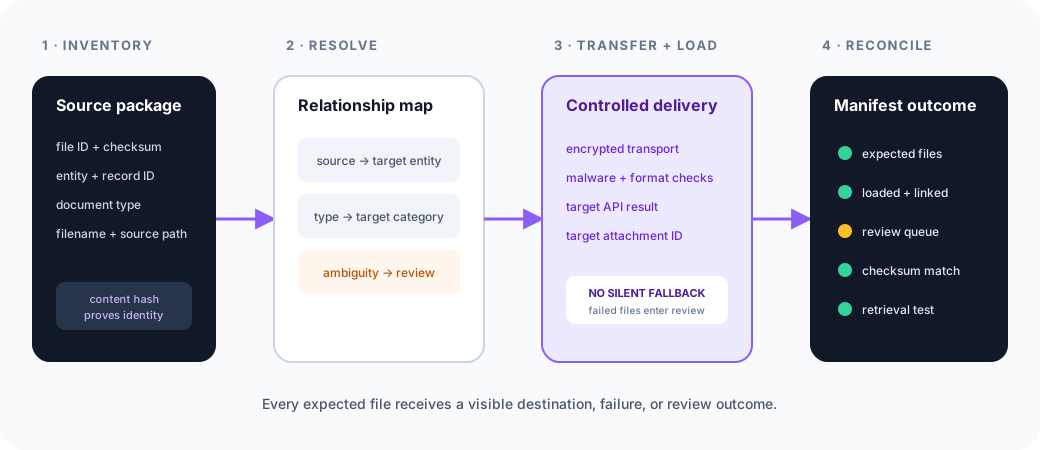
Before transferring content, inventory expected files and their attachment metadata. The manifest becomes the control record for extraction, relationship mapping, transfer, target loading, and reconciliation.
It should distinguish a missing source object from an unreadable file, an ambiguous parent, an unsupported target category, a rejected upload, and a successfully linked attachment. Those outcomes require different responses and should not collapse into one “failed” count.
Resolve entities before attaching files
A source resident ID cannot always be copied into the target. Residents may be deduplicated, units renumbered, owners consolidated, or leases split into new target objects. The file relationship must follow the approved source-to-target entity map.
This sequencing matters. Uploading files before target identities are stable can attach documents to temporary or duplicate records. The migration should resolve parent entities, retain crosswalk IDs, and then create target attachments using that approved mapping.
OCR helps classify and compare; it does not establish authority
OCR and document models can identify likely document types, names, unit numbers, dates, and lease terms. They are useful when source metadata is incomplete or a filename provides no context.
The extracted text is evidence, not a guaranteed answer. A scanned image may be incomplete, a lease may have a later addendum, and one package may mention several residents and dates. High-confidence matches can be automated under approved rules; ambiguous candidates should enter review with the relevant page or image region highlighted.
Document extraction can also support field-level comparison between leases and structured PMS values, but classification and legal interpretation remain separate decisions.
Files from scattered sources need source-specific lineage
Documents may come from the legacy PMS, a shared drive, an object-storage bucket, an accounting system, or a scanned paper archive. A unified ingestion process can bring those sources into one migration, but it should not erase where each item came from.
Source lineage helps reviewers distinguish an executed lease from a working copy, understand why duplicates exist, apply the right retention and security rules, and return to the original repository when evidence is incomplete.
Secure the content during transformation
Leases, screening documents, IDs, and financial records may contain sensitive personal information. Access should be task-scoped, sensitive fields masked where possible, working data retained only as long as needed, and exports restricted to approved destinations.
These controls belong inside the digital clean-room workflow. “In-memory” processing can reduce persistent intermediates, but it does not by itself control logs, exports, screenshots, model inputs, backups, or target access.
Reconcile usability, not only file count
A source count of 10,000 and a target count of 10,000 does not prove success. Validation should confirm that expected files are readable, checksums match, relationships point to the intended target entities, document categories are preserved, and authorized users can retrieve representative attachments through the target application.
The final report should account for every expected file as loaded and linked, intentionally excluded under an approved rule, or unresolved in a visible exception queue.
Migrate the paper trail as structured evidence
Elvity’s PropTech data onboarding platform inventories files with their source metadata, carries relationships through entity resolution, uses document intelligence to propose classifications and comparisons, and records target attachment outcomes for reconciliation.
The goal is not a zero-loss slogan. It is a migration process that can show which files were expected, where they went, what they belong to, and which exceptions still require a decision.
A document should arrive in the new PMS as part of the resident, lease, unit, or transaction it supports—not as an orphaned object waiting for someone to recognize its filename.
Move the attachment and its context
See how Elvity inventories, links, transfers, and reconciles documents alongside the structured records they support.