Extraction and loading are visible milestones in a property management migration. The work between them is less visible and often more complicated.
Source fields are mapped to a target schema. Dates and addresses are normalized. Duplicate residents and vendors are reviewed. Exceptions are sent to implementation specialists. Sample records are opened to understand why a rule failed.
This cleanup phase requires data to be changed and inspected. If it happens through downloaded CSVs and shared spreadsheets, the migration can create more uncontrolled copies than either the source or target system ever allowed.
The cleanup workspace becomes a new data system
A spreadsheet on a specialist’s laptop is not “just a file.” For the duration of the migration, it may contain tenant identities, financial history, screening information, bank details, lease terms, and links to documents. It has become a temporary data store—with few of the controls expected from a production PMS.
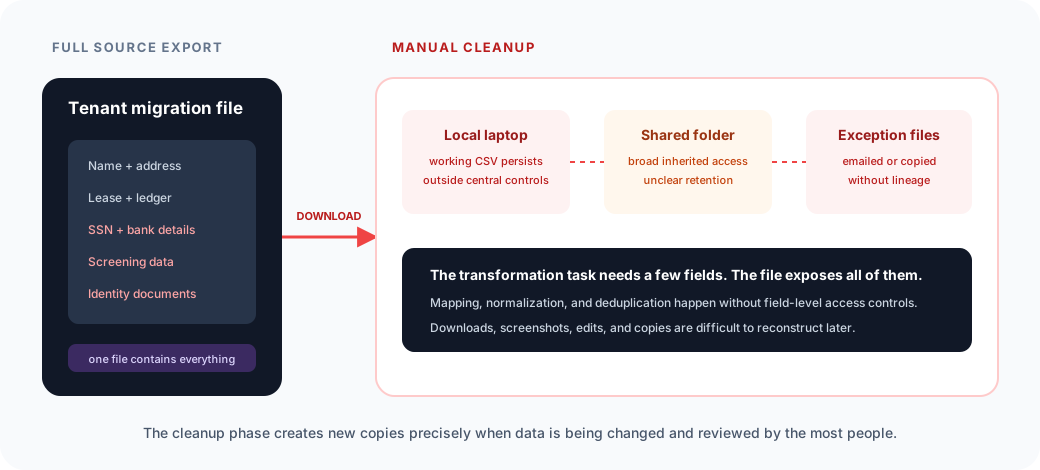
The transformation task may require ten fields while the working export exposes hundreds.
A digital clean room is a control boundary
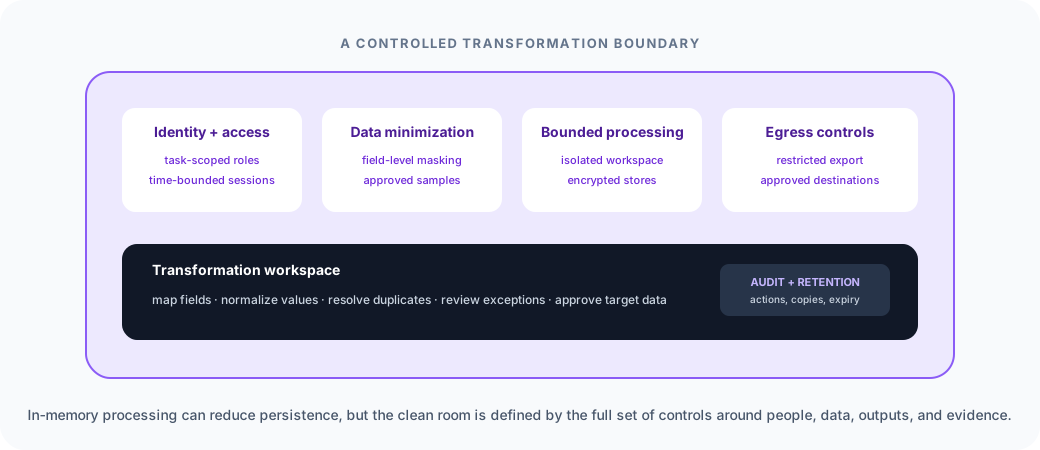
The phrase “digital clean room” is used in several data contexts. For migration, it should mean a bounded workspace where approved people and processes transform sensitive data under explicit access, visibility, export, retention, and audit rules.
It is not defined by one technical feature. Processing data in memory can reduce persistent working files, but it does not control screenshots, application logs, model inputs, exports, administrator access, backups, crash dumps, or the target data written after transformation.
| Control area | Spreadsheet workflow | Digital clean-room approach |
|---|---|---|
| Access | Anyone with the file can usually see every column | Task-scoped roles limit fields and actions |
| PII visibility | Full values remain visible during unrelated cleanup tasks | Sensitive fields are masked or tokenized unless required |
| Working copies | Downloads and duplicates spread across devices and folders | Processing stays inside an approved workspace with controlled export |
| Change history | Cell edits and copied versions are difficult to reconstruct | Transformations, overrides, and approvals are recorded |
| Retention | “Temporary” files remain until someone remembers to delete them | Expiry and deletion rules apply to data, logs, and generated outputs |
The six controls a clean room needs
1. Strong identity and task-scoped authorization
Access should be tied to a named person or workload, a defined migration, and a specific task. A reviewer fixing property addresses should not inherit visibility into tenant bank details because both fields happen to be in the same row.
2. Data minimization and field-level masking
The workspace should expose the smallest useful data set. Sensitive fields can be masked, tokenized, or omitted from views that do not require them. Review samples should use redacted or synthetic values when those values can answer the same question.
3. Controlled processing and storage
Transformation workloads should run in an isolated environment with encrypted transport and governed storage. If memory-only processing is used, the design should still account for spill files, diagnostics, logs, snapshots, and failure recovery.
4. Egress restrictions
A clean room loses its value if any user can export the full dataset. Downloads, clipboard actions, screenshots, API responses, and destinations should be considered according to the risk and technical capability of the environment.
5. Retention and deletion evidence
Working data needs a documented expiration condition. The policy should cover successful and failed runs, exception queues, logs, model inputs and outputs, exports, backups, and support artifacts—not only the primary staging table.
6. Audit evidence without sensitive replication
Logs should record who accessed the workspace, which transformation ran, what changed, which export occurred, and how an exception was resolved. They should avoid copying raw PII into diagnostic messages or change descriptions.
AI belongs inside the same boundary
AI can propose mappings, detect likely PII, normalize values, group duplicate candidates, and explain validation failures. That does not place model processing outside the clean-room design.
The team should know which fields are sent for inference, whether values can be minimized first, where the model runs, what is retained, how customer isolation works, and which outputs can trigger a target change. Human review and AI processing need separate identities, permissions, and evidence.
Compliance language does not replace control testing
FCRA and state privacy laws such as CCPA may impose obligations depending on the organization, data, and processing purpose. SOC 2 reports provide assurance about a service organization’s controls; they do not automatically make every customer workflow compliant.
Security teams should validate the actual migration data flow: endpoints, storage locations, identities, subprocessors, logs, retention behavior, export paths, and incident handling. “In memory,” “encrypted,” and “zero trust” are design claims that need supporting evidence.
The clean room ends only when temporary access ends
A migration is not finished when the target API returns success. The team must reconcile what loaded, close exception queues, revoke temporary credentials, expire working datasets, account for approved exports, and retain only the evidence required by policy.
Elvity’s PropTech data onboarding platform is designed to keep mapping, validation, deduplication, and exception review inside a controlled workflow rather than distributing full exports across local tools. Transformations and reviewer decisions remain traceable through the migration.
The objective is not to claim that sensitive data becomes risk-free while moving. It is to make the transformation phase as governed and reviewable as the systems on either side of it.
Keep cleanup inside a controlled workflow
See how Elvity handles mapping, normalization, and exception review without turning full tenant exports into unmanaged working files.