
Equipped with LLMs, companies are asking the question: "Can't I vibe code my data migration system?" The short answer is yes, but there is a massive gulf between a "working script" and an enterprise-grade pipeline. Discover the five operational realities of B2B data exchanges.
1. Hallucination Prevention (Deterministic Ingestion vs. Generative Guesswork)
LLMs are designed to be helpful, confident, and smooth. Unfortunately, this means that when they encounter ambiguous, malformed, or missing data, they will often try to "fix" it by hallucinating.
If you use a generative AI script to parse a client's multi-million row dataset, you run a massive risk: the LLM may quietly inject arbitrary values to make a row fit your target schema.
[!WARNING] The Risk: An LLM might look at an unrecognized billing code and decide to map it to a default category, or "correct" a phone number by adding digits. With critical customer data, these silent corrections are catastrophic.
To prevent this, an enterprise data engine cannot rely on raw LLM generation for ingestion. You need deterministic validation gates—such as rigid schema checking, mathematical range validations, and strict regex rules—to ensure that what is written to your database is the exact, unadulterated truth.
2. Bulletproof Traceability (The "Claude Said So" Problem)
In B2B data migrations, data is critical. You will eventually run into a situation where a customer, an auditor, or an executive demands to know why a specific cell in your database is populated with a certain number (e.g., why a SKU count is exactly `42`).
If your data pipeline is a series of vibe-coded AI scripts, your answer will likely be: "I don't know, Claude outputted that."
Needless to say, that will not fly in an audit.
[!IMPORTANT] The Standard: For critical data, every single record requires a clean audit trail. You must be able to trace every cell in your production database back to its exact origin in the raw client file—whether that is a specific cell coordinate in a messy spreadsheet or a highlighted sentence in a scanned PDF.
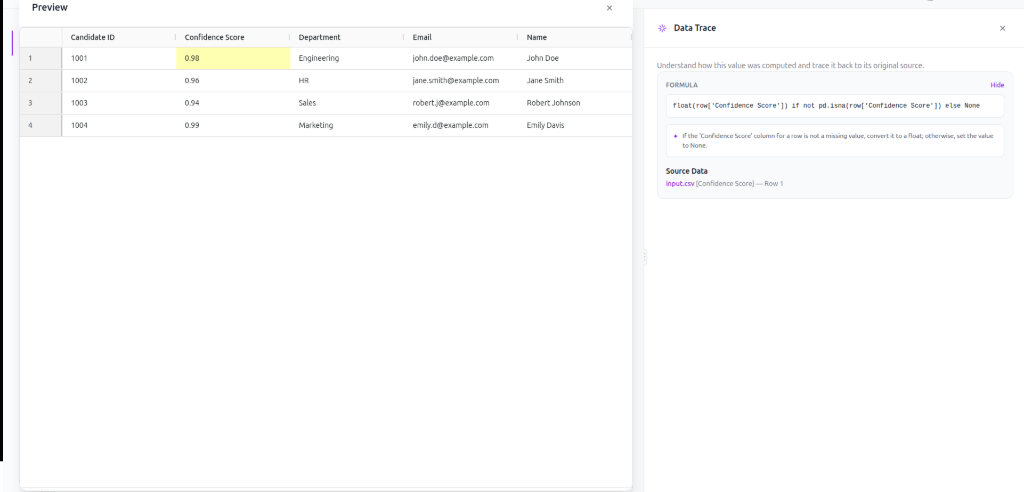
This level of granular auditability is what we call Cell Lineage. Without it, you are running a black-box data pipeline with zero accountability.
3. Operational Continuity (The Git Repository Knowledge Silo)
Imagine this scenario: Your lead developer builds a brilliant, custom AI-generated script to migrate a massive client’s catalog data. The migration works, the client is onboarded, and everyone is happy.
Three weeks later, the client uploads a new file format. The script breaks. But your lead developer is on vacation—or has left the company entirely.
The next engineer is handed a Git repository full of bespoke, vibe-coded Python scripts with no documentation, no unified interface, and no standard schema maps. They have to spend days reverse-engineering the prompts and code to figure out how to restart the pipeline.
True transferability requires a standardized environment. Your data onboarding system must make it easy for any non-technical operator or new hire to log in, inspect a client’s mapping rules, and manage the environment without needing to untangle spaghetti code.
4. Collaboration, Workflows, and Audit Trails
Data onboarding is rarely a solo activity. When a client uploads a file with missing, malformed, or ambiguous fields, the engineering team cannot—and should not—guess the corrections. You need the client to clarify the data, resolve the errors, and formally sign off on the changes.
If you are using custom scripts, how do you handle this collaboration?
- Do you email spreadsheets back and forth?
- Do you paste errors into Slack channels?
- Do you make manual database edits over Zoom?
None of these methods are secure, and none of them capture a decision-making history. You need a dedicated, collaborative Data Portal where clients can upload files, see error explanations written in plain English, resolve their own validation issues in the browser, and submit their signed-off data. This process ensures that every correction is visually verified and recorded as an audit trail for the future.
5. Ongoing Pipeline Maintenance (Handling the Inevitable Drift)
B2B data imports are almost never a "one-and-done" event. For logistics, e-commerce, and financial applications, data onboarding is a recurring daily or weekly process.
Your clients’ upstream systems will change. Next month, a vendor will update their export tool, and a column header will change from `Product_Cost` to `prod_price`.
Your custom migration script will crash, halting the entire ingestion process.
[!TIP] The Solution: You need a system that actively monitors recurring imports, automatically verifies data quality against your strict requirements, and applies self-healing AI patches (e.g., using fuzzy matching to automatically resolve shifted column headers) to keep your pipelines running with zero downtime.
Or... Just Use Elvity
You don’t need to turn your engineering team into "data onboarding infrastructure developers."
Elvity provides a production-ready, enterprise-grade data onboarding engine out of the box:
- Hallucination Defense: The LLM is strongly sandboxed and has no direct access to the data. It can only suggest actions to the user.
- Granular Traceability: Our universal Cell Lineage engine allows you to trace any cell in your database back to its exact coordinate or highlighted PDF source.
- No Code Silos: Our standardized visual platform means any non-technical operator can manage client templates and pick up exactly where the last person left off.
- Client-Guided Portals: Instantly spin up co-branded Data Portals (with Auto-Branding) where clients can upload files and correct their own errors, guided by our interactive AI Assistant.
- Self-Healing Resilience: When schema drift occurs, our Self-Healing AI Patches auto-match shifted columns, resume validation, and notify your team—ensuring zero downtime.
By all means, keep vibe coding your core application. Let your developers build the features that make your product unique.
But when it comes to the complex, high-risk, recurring infrastructure of B2B data exchanges? Skip the technical debt. Use Elvity.
Want to see how easy it is to standardize unstructured data and eliminate the "ingestion tax"? Learn more and request a demo at www.elvity.ai today.