A property management migration can include Social Security numbers, bank details, driver’s license images, screening reports, signed leases, and complete financial histories. The source and target platforms may both have mature security controls.
The migration between them is where those controls are easiest to lose.
Data is exported into files. Files are copied into staging folders. Specialists inspect samples, fix mappings, send exceptions to colleagues, and retain working copies for the next run. Every additional location, account, and manual handoff expands the attack surface.
The migration creates a temporary security perimeter
A traditional “white-glove” process often relies on CSV exports and spreadsheets because they are flexible and familiar. But once tenant data leaves the source PMS, its original permissions, masking rules, retention policies, and activity history do not automatically follow it.
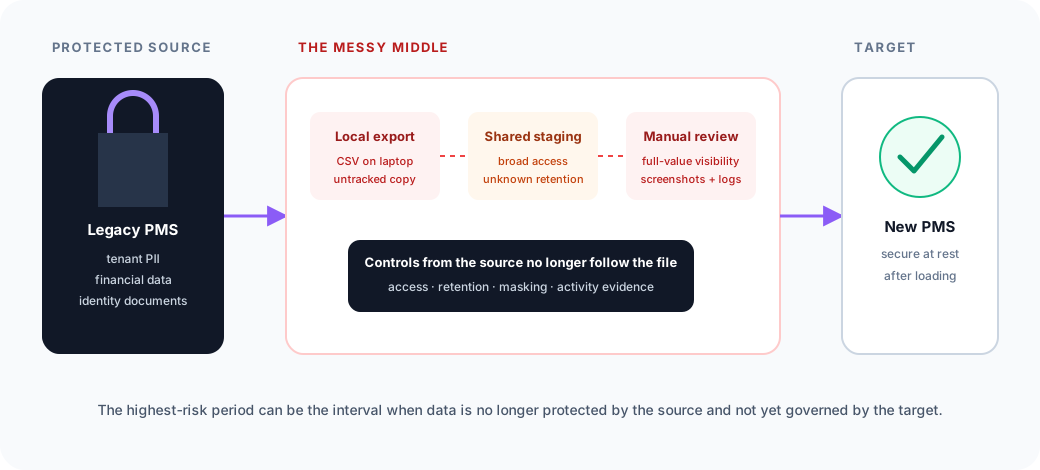
The source and target can both be secure while the temporary migration workspace remains poorly governed.
Zero trust is a migration operating model
Zero trust does not mean that every employee or system is assumed to be malicious. It means access is not granted simply because a person is on the migration team or a workload is inside the company network.
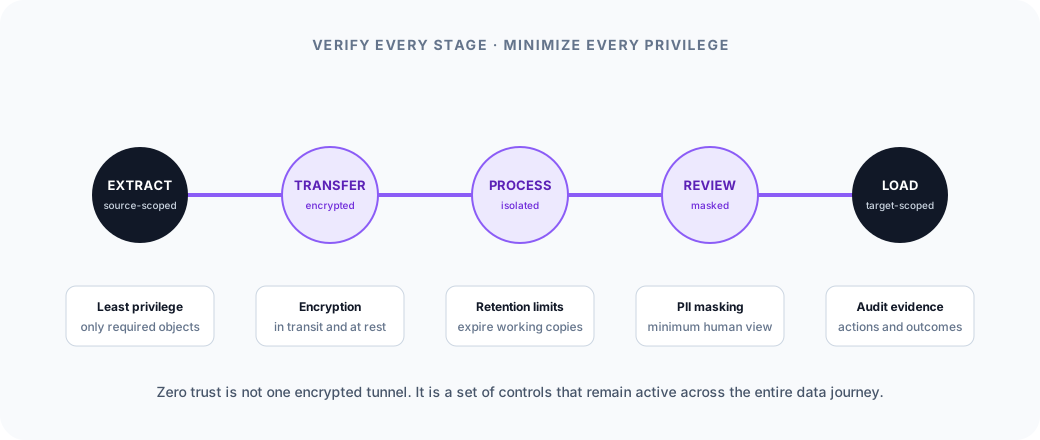
Every request should have a defined identity, approved purpose, limited scope, and auditable outcome. Applied to migration, that means the pipeline continuously answers:
- Which source objects does this process need to read?
- Which fields does this reviewer need to see in full?
- Where can temporary data be stored, and for how long?
- Which transformations changed a value?
- Can the team prove when working copies were removed?
Traditional migration vs. controlled ingestion
| Control area | Ad hoc file migration | Zero-trust migration approach |
|---|---|---|
| Extraction | Full exports created by a broad-access account | Source-scoped credentials read only approved entities and fields |
| Transfer | Files copied through email, local devices, or shared drives | Authenticated, encrypted service-to-service transfer |
| Human review | Reviewers see complete rows by default | Sensitive fields are masked unless full values are required and approved |
| Temporary storage | Working copies persist without a clear owner or deadline | Retention is defined, enforced, and evidenced |
| Change history | Spreadsheet edits and re-exports are difficult to reconstruct | Rules, overrides, actors, and load outcomes are logged |
Five controls that matter in the messy middle
1. Least-privilege extraction
A migration connector should not receive unrestricted source access merely because it is temporary. Permissions should be limited to the required properties, entities, fields, and time window. Separate credentials make migration activity easier to revoke and audit.
2. Encrypted transfer and controlled storage
Encryption in transit protects data moving between systems. Encryption at rest protects persisted staging data. Neither control is sufficient by itself: access policies, key management, backups, logs, and exports also determine who can reach the plaintext.
3. PII-aware review
An implementation specialist can validate a schema without seeing a full bank account or Social Security number. Interfaces should mask sensitive values by default and reveal them only when the task requires it. Sample datasets should minimize real PII where synthetic or redacted values can answer the same question.
4. Explicit retention and deletion
“Temporary” is not a retention policy. Working data should have a documented purpose, owner, expiration condition, and deletion evidence. Failed runs, exception exports, downloaded samples, application logs, and backups all need to be considered.
5. Chain-of-custody evidence
A useful audit trail records who initiated an extraction, what data scope was approved, which transformation rules ran, which manual overrides occurred, what reached the target, and how exceptions were resolved. It should support investigation without reproducing sensitive values in the log itself.
AI does not get a security exemption
AI can identify sensitive columns, propose mappings, classify documents, and explain validation failures. Those capabilities can reduce how much raw data a person needs to inspect.
They also introduce another processing boundary. A migration team needs to know which fields are sent to a model, where inference occurs, whether prompts or responses are retained, and how access is isolated between customers. Masking and minimization should happen before model access whenever the task permits it.
Compliance requires evidence, not architecture labels
CCPA and FCRA can create legal obligations depending on the data, organization, and use case. SOC 2 is an assurance framework used to evaluate controls; it is not a statute. None of them is satisfied simply by calling a pipeline “zero trust.”
Security reviewers need evidence: data-flow diagrams, access-control records, retention schedules, vendor boundaries, incident procedures, encryption configuration, and logs showing that the migration followed the approved process.
Secure onboarding starts before the first export
Security cannot be added after the data has already been downloaded to a laptop. The migration design must establish the source scope, processing boundaries, reviewer permissions, retention rules, and audit requirements before extraction begins.
Elvity’s PropTech data onboarding platform is designed around controlled ingestion: scoped source access, review workflows that limit unnecessary exposure, traceable transformations, and visible migration lineage. The goal is not to claim that movement can be risk-free. It is to make every access path and temporary copy intentional, bounded, and reviewable.
Tenant data should be governed throughout the journey—not only when it is sitting inside the source or target system.
Make the migration path reviewable
See how Elvity limits unnecessary data exposure and preserves evidence from extraction through target loading.